
Overview
https://<customer-acronym>.oneracehub.net/graphql demo, the endpoint is: https://demo.oneracehub.net/graphql- Opening this URL in a browser launches the Apollo Studio Playground
- Click Query your server to open the GraphQL Sandbox
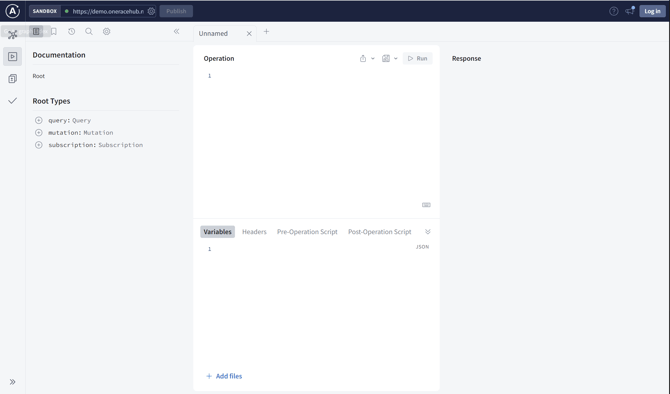
Check the API Connection
Use the version query to confirm the API is reachable. This query does not require authentication.
query Version {
  version
}
If the request succeeds, the server returns an HTTP 200 response together with the current server version.
Authenticate
- All queries and mutations except
loginrequire a valid authentication token. Tokens are issued via the login mutation and are valid for 7 days.
mutation Login {
  login(username: "your-username", password: "your-password") {
    token
  }
}
Expected response:
{
  "data": {
    "login": {
      "token": "~236 characters long string"
    }
  }
}
Once you have the token, pass it in the HTTP request header for all subsequent calls. The header key is Authorization.
Verify Authentication
Use the whoami query to confirm you are logged in and the token is working correctly. It returns the username of the account you are currently logged in with.
Request:
query WhoAmI {
  whoami {
    person {
      username
    }
  }
}
{
  "data": {
    "whoami": {
      "person": {
        "username": "your-username"
      }
    }
  }
}
Query Data
GraphQL allows you to nest multiple related data requests in a single query.
Example: Retrieve all race series with seasons and events
query RaceSeriesAll {
  raceSeriesAll {
    items {
      name
      seasons {
        name
        events {
          name
        }
      }
    }
  }
}
Example: Filter by race series name
Use the _operators filter to narrow results. The following query returns only the DTM and Formula 3 series:
query RaceSeriesAll {
  raceSeriesAll(filter: {_operators:  {
     name:  {
        in: ["DTM", "Formula3"]
     }
  }}) {
    items {
      name
      seasons {
        name
        events {
          name
        }
      }
    }
  }
}
ⓘ Array queries support both direct filters and _operators for more advanced filtering within lists.
Subscribe to Live Updates
Subscriptions deliver real-time events whenever data changes in the database.
For example, the following subscription listens for newly created jobs:
subscription JobAdded {
  jobAdded {
    _id
    description
  }
}
This subscription triggers every time a job is added to the database and returns the requested fields (_id and description).
If you already know a job ID, you can subscribe to updates for that specific job.
subscription JobUpdated($jobID: MongoID) {
  jobUpdated(jobID: $jobID) {
  _id
  description
  }
}
Accessing the API with Excel / VBA
PACETEQ provides an Excel/VBA template with a built-in function to retrieve a login token from your endpoint and make API calls directly from your spreadsheet. Contact our Support Team to request the template.